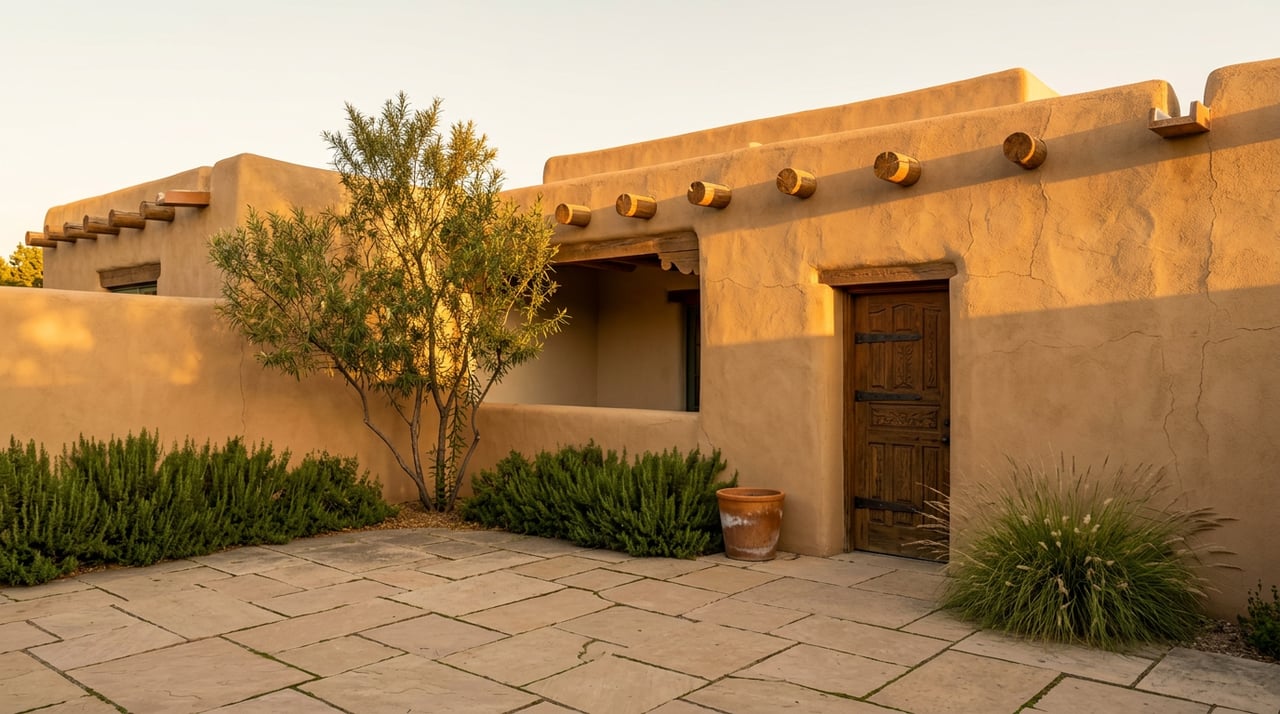
El Prado's Views Are Cheaper Than Ranchitos' Water
September 24, 2026
September 24, 2026
Ask a buyer in the Taos corridor which piece of land costs more per acre, the mesa parcel in El Prado with the wide-open Sangre de Cristo view or the shaded, irrigated lot in Ranchitos a few minutes from the Plaza, and most will guess El Prado. The view sells itself. The lots are bigger. The marketing has always leaned on elevation and vista.
The land data says the opposite. Recent listings across El Prado average somewhere around $27,885 per acre, while land in the Ranchos de Taos and Ranchitos corridor averages closer to $112,636 per acre, roughly four times as much for parcels that often sit on smaller footprints with less dramatic sightlines. Taos County as a whole lands in between, with land listings running a median of about $60,614 per acre. If you are comparing these two pockets of the same neighborhood guide, the price gap is not explained by acreage or scenery. It is explained by water.
El Prado sits on the mesa along the corridor toward Taos Ski Valley, three miles north of downtown. It is dry high desert. Domestic water there typically comes from a private well or a hookup with the El Prado Water and Sanitation District, a municipal-style utility built to serve household use, not irrigation.
Ranchitos and the broader Ranchos de Taos area south and southwest of the Plaza sit in the river valley, threaded by the historic acequia system that has irrigated this ground for generations. Cottonwoods grow along the ditches. Small orchards and gardens are common. That water is not incidental. It is a legal right attached to specific parcels, as Modrall explains, and it is the reason land there trades at a multiple of what a mesa lot commands, even when the mesa lot has the better view and the bigger fence line.
This is the part a lot of buyers miss until they are deep into a purchase contract: in New Mexico, land value and water value are not the same line item, and the neighborhood that looks like the premium address on paper is sometimes the one paying less for exactly that reason.
The acequia system running through the Ranchitos and Ranchos de Taos corridor is older than the state itself. The Taos News traces water rights disputes in the valley back to an 1893 decree governing the Rio Lucero. Further back still is a Spanish land grant tied to a sargento mayor named Diego Lucero de Godoy, whose name is attached to both a river and the grant that predates New Mexico statehood by centuries. That history is not trivia.
The system is organized locally. A mayordomo manages day to day operations on a given ditch. Parciantes are the members. In the broader Taos Valley, the Office of the State Engineer says that 55 individual acequias belong to the Taos Valley Acequia Association, which represents them collectively on shared issues like water sharing and priority administration. According to Congress, Upper Ranchitos itself has its own Mutual Domestic Water Consumers Association, one of twelve such associations recognized in the 2010 settlement of the decades-long Taos Pueblo water rights litigation, a case that took until 2013 to fully resolve after negotiations that began in 1989.
El Prado has none of this infrastructure because it does not need it. There is no acequia to join, no mayordomo to coordinate with. That absence is part of why the land costs less. You are buying the view and the elevation, not a share in a centuries-old water system.
Here is the friction that catches buyers off guard once they are under contract on an acequia-served parcel. In New Mexico, irrigation water rights are legally appurtenant to the land, meaning they transfer automatically with the deed even if the deed says nothing about water at all. If a seller wants to keep the water rights and sell only the dirt, that reservation has to be spelled out explicitly. Silence defaults to the buyer getting the water.
That sounds like good news until you consider the title history. This is why title work on acequia-served property in the Taos valley often takes longer and asks more questions than a standard residential closing.
New Mexico's own residential property disclosure requirements reflect how central this issue is here. According to the New Mexico residential property disclosure statement, sellers are required to address water rights and acequia membership directly in the written disclosure statement delivered to buyers, alongside more familiar items like structural condition and mechanical systems. It is one of the few disclosure categories that is genuinely regional. A seller in Ranchitos does.
Transferring water rights out of an acequia, or changing how they're used, adds another layer. According to Lorman, New Mexico law has required acequia commission approval for certain transfers since 2003. This is not paperwork you want to discover exists after you've already opened escrow.
| El Prado | Ranchitos / Ranchos de Taos corridor | |
|---|---|---|
| Setting | Elevated mesa, open views | River valley, cottonwood canopy |
| Water source | Private well or EPWSD hookup | Acequia irrigation rights plus domestic well |
| Typical lot character | Larger, drier parcels | Smaller, irrigated parcels |
| Governance | Utility district for domestic water | Mayordomo, parciantes, acequia bylaws |
| Distance to Plaza | About 3 miles north | Walking or biking distance |
| Average land price per acre | Roughly $27,885 | Roughly $112,636 |
If you are drawn to El Prado for the view and the breathing room, know that you are buying land largely uncoupled from the valley's water history. Your due diligence looks like a standard well and utility check.
If Ranchitos or the Ranchos de Taos corridor is on your list because you want the green belt, the walkability, or a working garden, budget real time for water diligence before you get to closing. Ask for written confirmation from the mayordomo on membership status, dues, and any pending assessments. Order a current survey that shows the ditch, headgates, and turnouts. Pull the Office of the State Engineer's file on the parcel to confirm the priority date and check for any prior severance of the water right from the land. A New Mexico attorney with water law experience is worth the fee if anything in that file looks unclear.
None of this changes with the broader market. Taos County has moved into more buyer-favorable territory through 2026, with inventory elevated and days on market stretching longer than they were a year earlier. Homes and land priced under $1M, where most transactions in this market actually happen, have still appreciated at a modest and steady pace even as headline medians get pulled around by a smaller number of higher-priced sales. A softer market gives buyers more room to negotiate price. It does not shorten the acequia paperwork.
If I buy land in El Prado, do I automatically get water rights too? Not the way you would in Ranchitos. El Prado properties are typically served by a private well or the El Prado Water and Sanitation District, which covers domestic use. That is a different legal category from acequia irrigation rights, which are tied to specific parcels in the valley.
What does a mayordomo actually do? A mayordomo manages the day-to-day operation of an acequia, including coordinating seasonal cleaning and handling disputes among members. If you buy acequia-served land, you will likely deal with this person directly before and after closing.
Can I lose water rights if I stop using them? According to Acequia de la Puebla, only a court can make the final determination on forfeiture or abandonment, not the acequia and not the state engineer's office alone. This is one more reason a title history check matters before you buy.
Comparing neighborhoods on price per square foot only tells part of the story in a place like Taos. If you want to talk through what a specific parcel in El Prado or Ranchitos actually comes with, reach out to Mark & Chase Rochester at Summit Group. Contact us.
This article is general information, not legal, tax or financial advice. Consult a qualified professional about your situation.

The Decisions That Shape a Successful Sale in Santa Fe, NM.
Reaching the Buyers Who Want a Home Like Yours in Santa Fe, NM.

Getting a Home Ready for Buyers in Santa Fe, NM.
What the Right List Price Earns a Seller in Santa Fe, NM.

Design, Renovation & Remodeling
Where in Santa Fe to find the best pieces, from rugs to chandeliers.
Summit Group Real Estate Professionals offers unmatched real estate expertise in Northern New Mexico with over 35 years of market knowledge. Our team combines local roots with global reach through Berkshire Hathaway HomeServices, providing dedicated service for both buyers and sellers.